
AI Citations: Why Source Checking Matters More Than Ever

Key Takeaways:
Generative AI has accelerated research, but it has also made source verification more complex. AI-generated citations can appear credible while leading to weak, vague, or recycled sources.
Strong thought leadership still depends on original data, credible evidence, and practical guidance.
The rise of AI content increases the existing risk of echo chambers, where weak claims gain legitimacy through repetition.
Editorial rigor now matters more in the age of generative AI. Source-checking, transparency, and slower, more careful publishing are competitive advantages.
The future of thought leadership belongs to organizations that pair AI efficiency with human judgment.
By Rhea Wessel
Generative AI has made research faster than ever. But it has also made the simple act of checking a source unexpectedly complicated.
There’s a moment I keep returning to: I’m looking at a list of citations in a commissioned research report that a client gave me, work created with the help of generative AI. I click on one link. Then another. And another. And I keep falling down rabbit holes.
On the surface, the research looked robust. It included links to sources and appeared technical but as I dug deeper, the floor kept falling away. Sources included blogs of uncertain origin and articles, even on reputable websites, that did not cite their sources.
Some materials that did include attribution for their cases and data points provided only vague references.
I knew that a machine had helped write the commissioned desktop research I received. But how much of what the research pulled together had also been written by a machine?
This is the paradox we now face.
The act of citation, once the reliable compass of journalists, academics, and credible creators, is now simultaneously easier and more treacherous than ever.
With AI Citations, The Old Rules No Longer Apply
As a journalist trained to pursue editorial rigor, I was taught to follow the citation trail to its source. Editors drilled it into us: “Get the original!”
If you can’t, find a credible institution that has.
We maintained a healthy skepticism for statements that began with “sources say.” We looked for names, numbers, and the paper trail to the facts.
Today, AI can generate its own footnotes and citations, not to mention entire reports. We are flooded with references that appear solid at first glance.
Relying on questionable, machine-picked references risks creating what some observers call a “desert of stories.” This is when a flood of shallow statistics replaces the deep-dive case study interviews that once gave thought leadership its depth and power.
But citations are no longer a guarantee of veracity. Instead, they are part of a new terrain we must navigate. Where does human knowledge end and machine-generated synthesis begin?
Even before generative AI, there was a creeping erosion of rigor.
Many creators had already begun settling for what some critics call “internet mush,” summaries of summaries that slowly erode the original source.
I remember reading reports where a subject-matter expert at a consulting company would cite a figure attributed simply to “industry sources.” Journalists would pick it up, and then it would appear in the press as “according to XYZ Consulting.” Suddenly, the number became legitimate through repetition rather than investigation.
Now magnify this dynamic with generative AI. We are only a few steps away from becoming a society of parrots quoting parrots quoting machines.
Thought Leadership Demands Rigor With AI Citations
As someone who works in thought leadership, I feel this tension acutely. My clients rely on me to help elevate their ideas and ensure their content stands on a foundation of facts.
That means doing the grunt work. Tracing sources. Verifying data. Reading the original papers.
It is not glamorous work. It is often tedious. But it is essential. Without it, thought leadership quickly collapses into something without integrity.
Tim Reason, Deputy Editor & VP at Bain & Company, said in an interview how the purpose of thought leadership “is not leads or conversion, but to be part of our clients’ conversations about pressing business issues by offering differentiated insights.” Integrity is the only way to earn a place among the handful of organizations that executives actually trust and follow.
The thought leadership field is actively working to address these challenges. The Global Thought Leadership Institute, where I serve as a board member, is developing standards for high-quality content, including sourcing practices. We understand that shared norms for trustworthy thought leadership are urgently needed.
The New Psychology Behind Citations
There is also a cognitive shift happening around citations.
Clicking a citation today no longer gives us a clear answer or a definitive source. It gives us options, often too many of them.
You may discover something solid. But you may also find yourself caught in an infinite regress of interpretations, summaries, and machine-generated variants. Each may look slightly different, creating the impression of multiple independent sources.
But the question remains: where is the original?
The result is citation fatigue, creeping distrust, and sometimes even intellectual paralysis.
Who realistically has time to vet every source in a forty-page report assembled with generative AI?
And yet, how can we afford not to?
Research once felt linear: read, evaluate, cite.
Now it feels uncertain. Like swimming in a pool where you are never quite sure whether the bottom is two feet below you or two hundred.
This is where my journalistic roots are both a burden and a guide.
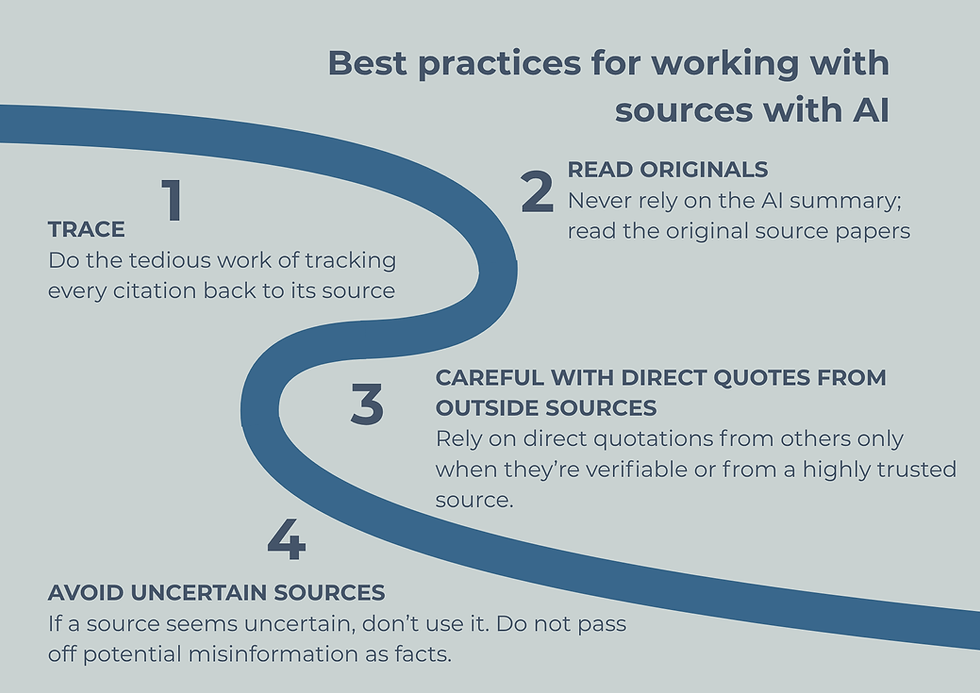
Journalists were trained to run down sources: I was trained to sniff out the weak link in a chain of sources. But many people writing for publication today were not.
They may be brilliant thinkers. But they have not necessarily been trained to question a seemingly credible post, reverse-image search a chart, or ask whether a blog entry may simply paraphrase a machine-generated output.
We are living through a disruption in knowledge production.
The result is a proliferation of “insight” that is not insight at all. It is echoes.
We risk becoming monkeys quoting monkeys who are quoting machines.
We Must Slow Down With AI Citations
When I reviewed that research report from my client, I realized I could easily spend days chasing every citation to its origin. In fact, I nearly did. But deadlines loomed and expectations pressed.
In the end, I made a deliberate choice. I cited sparingly. I used direct quotations where I could verify them. And when a source seemed uncertain, I labeled it clearly so it could be vetted later.
This is the discipline thought leaders must now adopt.
In the era of generative AI, editorial rigor must increase rather than decrease.
We must slow down and reassert that great thought leadership is not fast content. It is written, constructed, and edited with care. Brick by brick. Source by source.
This moment calls for ethical reflection. Do we want to become content factories producing gloss without grounding, quoting one another until we forget what was ever fact in the first place?
Despite all of this, I remain hopeful.
If we recommit to quality, transparency, and the sacred practice of source checking, we can elevate the entire field.
The heart of thought leadership is integrity. And integrity shows up in the citations.
Citations are not decorations. They are the foundation of trust.
So here is my call to you.
Be the one who checks. Be the one who follows the trail behind the AI citation. Be the one who says, “This isn’t good enough. Let’s dig deeper.”
-Rhea Wessel is the author of Write Like a Thought Leader and a member of the board of the Global Thought Leadership Institute.
Why are AI citations risky? They often look credible at first glance, but some lead to vague sources, recycled summaries, or nonexistent material. Without verification, they can weaken trust and spread misinformation.
Can generative AI hallucinate sources? Yes. Generative AI systems can fabricate facts, quotes, statistics, or citations. This is commonly referred to as hallucination.
Why do citations matter in thought leadership? Citations help establish credibility, transparency, and trust. Strong thought leadership depends on evidence-backed ideas, not unsupported opinion.
How is AI used in research? AI is valuable for summarizing information, organizing notes, identifying themes, and accelerating early-stage research. Human review is still essential for accuracy and judgment.
What is citation fatigue? Citation fatigue occurs when readers face too many links, summaries, and versions of the same source, making it difficult to identify the original evidence.
How can leaders build trust with AI-assisted content? Use AI responsibly, verify claims, cite primary sources, disclose methods when relevant, and prioritize substance over speed.


