
Why SMEs Belong at the Heart of Thought Leadership

Key Takeaways:
SMEs are the primary source of credibility and must be involved in content creation from ideation onward.
Getting your SMEs involved too late weakens differentiation and limits strategic value, while early SME engagement strengthens ideation, relevance, and market alignment.
Effective thought leadership requires structured support of company experts, including editorial guidance and coaching.
A culture that values knowledge sharing is essential for sustained thought-leadership impact.
If your organization is serious about competing on thought leadership, then your subject-matter experts (SMEs) need to sit at the heart of your strategy, not just as contributors or reviewers of the things you publish, but as active co-creators.
The reason is simple. In thought leadership, credibility matters more than promotion.
Recent research emphasizes this point. The 2025 Edelman–LinkedIn B2B Thought Leadership Impact Report found that 71% of "hidden buyers" (the internal influencers who quietly shape purchasing decisions) state that thought leadership is a more trustworthy way to assess a company's capabilities and competence than traditional marketing materials or product sheets. That finding highlights the central role of SMEs as those who lend a company's thought leadership credibility and authenticity.
In my view, SMEs must be involved from the very beginning of content ideation through development and delivery. Anything less means leaving your sharpest thinking and your deepest values on the table.
It is not a stretch to say that your company’s SMEs are your thought leadership engine.
They connect abstract insights to real-world client challenges. And they are often the face of trust in long-standing relationships.
Yet in many organizations, SMEs are still treated as optional additions. Their input is sought late in the content development cycle. They are asked to “review and approve” instead of “frame and guide.”
That approach is more than a missed opportunity. It reflects a misunderstanding of how thought leadership actually works.
Let me explain why.
SMEs And Thought Leadership Meet The News Hook
We see how expertise can quickly move to the center of public conversation when complex policy issues dominate the news cycle. One notable example comes from the climate debate. In Speed & Scale, both a project and a book, venture capital firm Kleiner Perkins applied the business framework of objectives and key results to the global challenge of reducing emissions. By translating a vast policy and regulatory challenge into a structured plan for action, the project showed how expert thinking can turn complexity into a clear and influential narrative.
This is the moment when your once obscure SME becomes a hot commodity.
If you have been enabling their thought leadership all along, you are ready. Their voice is already present in the conversation. You have helped shape their point of view. There may already be a LinkedIn article circulating, a white paper that anticipated a shift, or a podcast episode in which the expert explains the nuances clearly and succinctly.
If you have not done that work in advance, the situation looks very different:
When a big news event hits, such as tariffs, you are scrambling. You are trying to extract content from someone under pressure. You are chasing reactive soundbites instead of leading the conversation.
This dynamic could involve any type of expert. The news cycle changes, but the principle remains the same. Your SMEs are your strongest source of relevance, credibility, and timely insight when a story comes along that can be used as a news peg. Again, this only works if you invest in enabling your SMEs before the spotlight arrives.
Without Your SMEs, You’ll Have An Ideation Gap
Too often, content teams assume their role is to create and push content. They gather insights from SMEs, distill them into brand-friendly formats, and publish. SMEs are positioned as input providers or validators.
I’m arguing that the strongest thought leadership begins well before any words are written, and that starts with enabling your SMEs to ideate and write.

One of the strongest arguments for involving SMEs early in the content-creation process is that they are already thinking this way. They observe trends in real time. They hear client questions that signal emerging gaps in the market. When organizations wait until after ideation to involve them, they cut themselves off from a critical source of original thinking.
Thought leadership is not a performance. It is a practice.
In my book “Write Like a Thought Leader”, I explain how experts can capture and shape their own ideas. I have also spoken with the founders of leading thought leadership consultancies about how successful firms empower SMEs not just to speak, but to shape the narrative from the beginning.
This does not mean every SME becomes a writer. It does mean they must become active generators of ideas, and they must feel supported in that role. Seowhui Tan, global head of thought leadership marketing at Shell, observed in the 2024 Edelman-LinkedIn B2B Thought Leadership Impact Report, “If you’re not helping your customers think about their challenges in new ways, someone else will.” For SMEs, that insight captures the stakes. Sharing expertise is not only about visibility. It is about helping clients rethink the problems they face.
A Higher Profile For Your Company’s SME’s Is A Form Of Recognition
There is another important dimension to elevating your SMEs to thought leadership: they want a higher professional profile within the company and externally.
They want their work to have a broader impact. They want recognition for the expertise they have built over years, sometimes decades.
Yet they often do not know where to begin. They may struggle to translate deep technical knowledge into a public conversation. They worry about sounding simplistic in a space that rewards clarity. They may also fear that publishing will appear self-promotional or distract from their core responsibilities.
This is where organizational support becomes essential. Firms that succeed with thought leadership put systems in place to support SME participation.
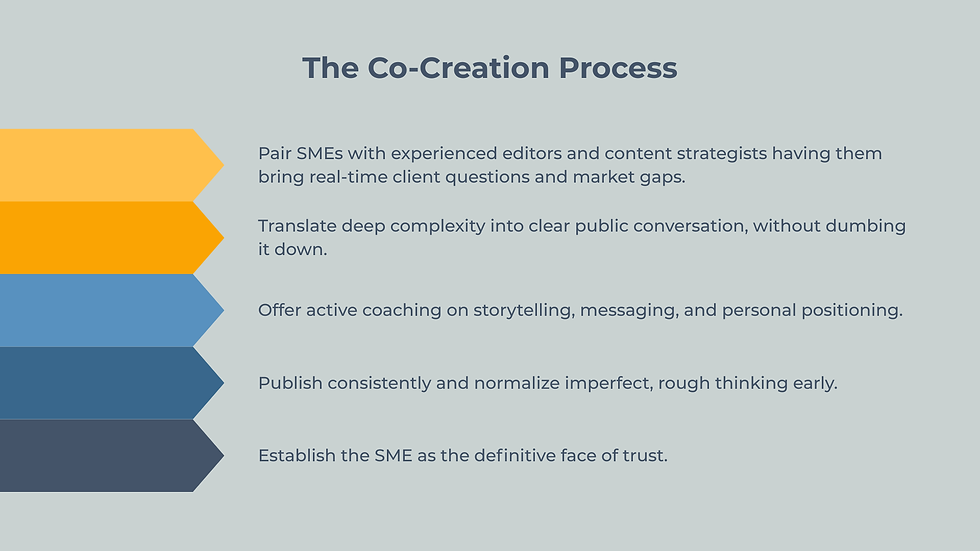
One example is our own Thought Leadership Writing Incubator developed by The Institute for Thought Leadership. The program guides internal experts through a structured process that begins with idea development and enables experts to write in an engaging way. Experts learn to express their own thinking with clarity and confidence. Over time, this approach helps organizations build a steady pipeline of expert insights and strengthen their SMEs' content-creation capabilities.
The Cultural Shift Needed When Enabling Your SMEs For Thought Leadership
Of course, enabling SMEs isn’t just logistical. It is cultural.
Organizations must create an environment where sharing ideas is encouraged, where publishing is viewed as a contribution rather than a risk, and where curiosity is recognized as a strength.
That culture allows people to test ideas early. It allows rough thinking to evolve into clear insight.
When that environment exists, SMEs are more likely to contribute new thinking. They begin bringing ideas forward instead of waiting to be asked. Content professionals can then do what they do best: shaping and amplifying those ideas for greater impact.
In “Building culture from the outside in” by Dave Ulrich, the Rensis Likert Professor at the University of Michigan, says culture ultimately reflects what an organization is known for by its stakeholders. When firms intentionally cultivate a culture that values expertise and knowledge sharing, that reputation can create a powerful halo effect. It strengthens trust with clients and partners and helps organizations remain resilient during leadership changes or market disruption.
SMEs and Communicators: Better Together
Thought leadership isn’t just about marketing. It is a shared mission between experts and communicators.
The strongest thought leadership does more than describe what a company knows. It shapes how an industry understands emerging challenges.
That cannot happen without the people who are closest to the work.
Your SMEs are the heartbeat of your insights. They see what others miss. They know which questions matter most. And they are the voices your clients trust when the stakes are high.
So the next time your team plans a content calendar, ask a simple question. Have we invited our SMEs into the ideation room?
Are we tapping their thinking, or only their time?
The future of your thought leadership depends on your ability to turn internal expertise into external influence.
And that transformation begins not with better output, but with deeper input.
That is why the link between SMEs and thought leadership is not optional. It is essential.
-Rhea Wessel is a writer and the founder of The Institute for Thought Leadership.
FAQs
Why are SMEs important for thought leadership? SMEs bring credibility, industry knowledge, and firsthand client insight, which makes thought leadership more trustworthy and relevant to decision-makers.
When should SMEs be involved in the content process? SMEs should be involved from the ideation stage through to content development and delivery to ensure originality and strategic alignment.
How do SMEs improve content quality? They contribute unique perspectives, identify emerging trends, and connect insights to real client challenges, resulting in more differentiated and actionable content.
Do SMEs need to write content themselves? No. SMEs need to provide ideas and expertise, while editors and strategists can support structure, clarity, and storytelling. However, there are many benefits to having your SMEs write themselves.
How can companies support SMEs in thought leadership? Organizations can provide editorial support, coaching, structured ideation sessions, and recognize thought leadership as part of career development.
What are the benefits of SME-led thought leadership? It builds trust, strengthens brand authority, supports business development, and positions the company as a leader in its industry.


